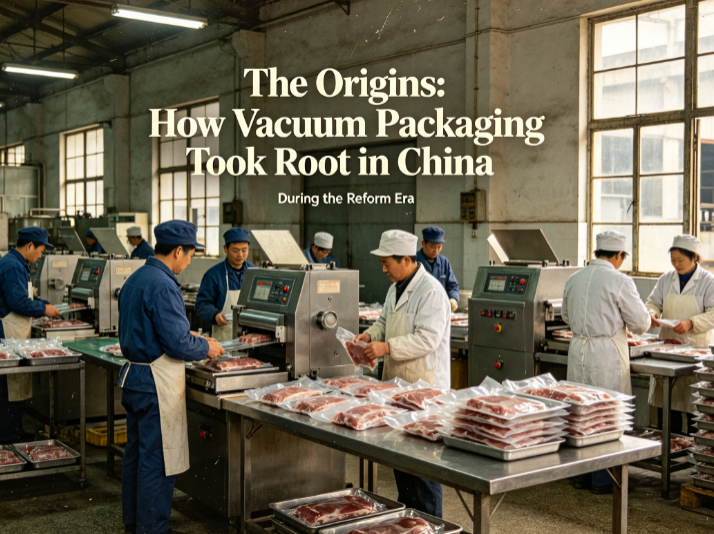
Slug: china-vacuum-packaging-origins-1980s-reform-era Category: Industry History — China | Reading Time: 6 mins Meta
Description: China’s vacuum packaging industry was born from the reform era of the early 1980s. Explore how the introduction
of foreign technology sparked a domestic revolution in food preservation and industrial sealing. Target Keywords: China
vacuum packaging history, 1980s reform era packaging, Chinese food packaging development, YGPACK China heritage
Before 1978, China had virtually no modern vacuum packaging industry to speak of. Food preservation relied on traditional
methods — salting, drying, smoking, and fermentation — that had sustained Chinese civilization for millennia but were wholly
inadequate for the demands of a modernizing economy. Most packaged goods were stored in glass jars or basic tin cans, and
the concept of flexible vacuum-sealed pouches was unknown to the vast majority of Chinese manufacturers and consumers
alike.
The turning point came with Deng Xiaoping’s Reform and Opening-Up Policy (改革开放) in 1978. As China’s economy began
its historic transformation, two things happened simultaneously: domestic food production surged with agricultural reforms,
and foreign packaged goods began appearing in cities through special economic zones, exposing consumers and
manufacturers to modern packaging standards for the first time.
The First Wave: Technology Import (Early 1980s) China’s vacuum packaging technology development in the early 1980s
followed the national pattern of “technology import and self-digestion.” The government and state-owned food enterprises
began importing vacuum packaging machinery from Italy, Germany, and Japan — the dominant global equipment producers
of the era — to support the rapid expansion of processed meat and seafood production.
The first domestically packaged vacuum products to reach Chinese consumers were primarily processed meat products —
vacuum-sealed sausages, ham products, and luncheon meats — produced by large state-owned food enterprises in cities like
Shanghai, Beijing, and Guangzhou. These products were revolutionary in the Chinese market: they offered unprecedented
freshness, hygiene, and shelf-life extension compared to anything previously available.
The National Standard Foundation Alongside technology import, China’s government moved to establish regulatory
infrastructure. Initial food packaging standards were developed to address hygiene concerns in the production of vacuum
sealed meat products, creating the first framework for what would eventually become today’s comprehensive GB (Guóbiāo / 国
标) food safety packaging standards.
YGPACK’s Connection to This History: YGPACK was built by engineers who lived through this transformative era — who
witnessed the birth of China’s vacuum packaging industry firsthand. Our machines carry the institutional memory of decades
of Chinese industrial development, refined by modern engineering and scaled for global export.
Contact YGPACK to Learn About Our Full Product Range:
Phone: +86-4008-351-357
WhatsApp: +86-18018694247
Email:
roby@ygpack.com
Website:
www.ygpack.com