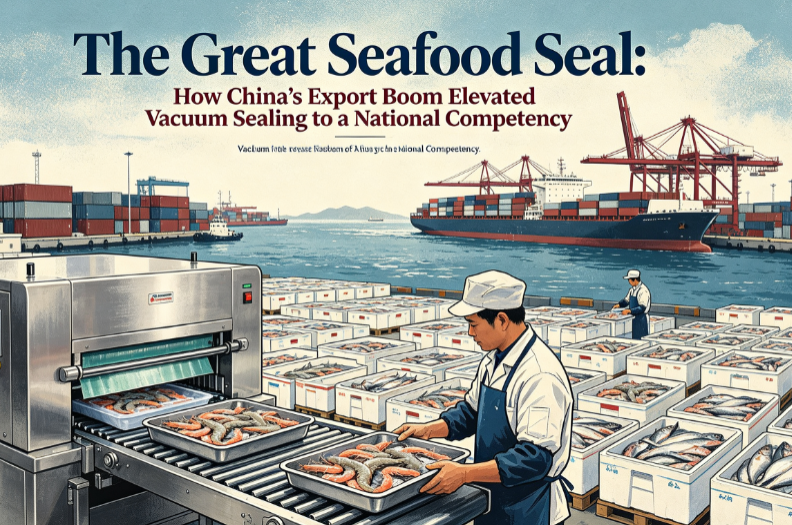
Slug: china-seafood-export-vacuum-packaging-national-competency Category: Industry History — China | Reading Time: 5
mins Meta Description: China’s rise as the world’s largest seafood exporter was inseparable from its vacuum packaging
capability. Explore how HACCP compliance and industrial sealing transformed China’s fishery industry. Target Keywords:
China seafood vacuum packaging, Chinese seafood export HACCP, industrial vacuum sealer seafood, YGPACK seafood solutions
If a single industry drove the formative development of China’s vacuum packaging machinery sector more than any other, it
was seafood processing and export. China’s coastline stretches over 18,000 kilometers, and its maritime provinces —
Shandong, Fujian, Guangdong, Zhejiang, Liaoning — produce billions of tons of fish, shrimp, crab, abalone, and shellfish
annually. As China’s seafood export volumes grew through the 1990s and 2000s, the technical requirements for packaging
became increasingly stringent.
Japan was the first major export destination to impose strict vacuum packaging requirements on Chinese seafood. Japanese
importers demanded that fresh and frozen seafood — particularly shrimp, flatfish, and sea cucumber — be vacuum-sealed in
transparent, food-grade film with verifiable seal integrity before customs clearance. This external quality standard acted as a
powerful catalyst for Chinese seafood processors to invest in reliable, commercial-grade vacuum packaging machinery.
HACCP and the International Standards Leap: The adoption of HACCP (Hazard Analysis and Critical Control Points)
certification — first driven by the US FDA’s mandatory HACCP regulations for seafood imports (21 CFR Part 123, effective 1997)
— further elevated the technical sophistication required of Chinese vacuum packaging operations. For a Chinese seafood plant
to export to the United States or European Union, its entire production process — including vacuum sealing — had to be
documented, validated, and audited by international food safety authorities.
This requirement forced Chinese packaging machinery manufacturers to dramatically improve the precision, consistency, and
hygiene design of their sealing equipment. The era saw the introduction of:
Full SUS304 stainless steel machine construction — replacing painted carbon steel that corroded in wet seafood
environments
Programmable vacuum level controls — replacing fixed, non-adjustable vacuum systems
Rapid wash-down designs — allowing full machine sanitization between production lots
Today, China is the world’s largest seafood exporter by volume, and the vacuum packaging machinery sector that supports it is
sophisticated enough to meet the most demanding food safety requirements globally.
YGPACK Seafood Sealing Solutions — Built for Export Standards:
Phone: +86-4008-351-357
WhatsApp: +86-18018694247
Email:
roby@ygpack.com
Website:
www.ygpack.com